Opinion: Brick by brick, the wall between
religion and government is collapsing in America Opinion by
Barbara Perry Updated 1715 GMT
(0115 HKT) June 29, 2022
click link for more
Brick
by brick, if not by bulldozer, the wall between religion and
government is collapsing. Does it matter? It does if the United
States still wants not only to protect religion from government
but government from religion.
As
the founders feared, when religious faith becomes the guiding
force in politics, the historic American experiment in creating a
pluralistic republic is most at risk. Allowing the utmost
religious freedom, within the bounds of high walls between church
and state, has spared the US from the kinds of religious wars that
have plagued human history and riled modern nations.
June 2022 The Guardian News
How the Christian right took over the
judiciary and changed America
The
supreme court decision in Dobbs v Jackson Women’s Health
Organization, which reverses the constitutional abortion
rights that American women have enjoyed over the past 50
years, has come as a surprise to many voters. A majority,
after all, support reproductive rights and regard their
abolition as regressive and barbaric.
At the core of the Dobbs decision lies the
conviction that the power of government can and should be used
to impose a certain moral and religious vision – a supposedly
biblical and regressive understanding of the Christian
religion – on the population at large.
This supreme court has already made clear how
swiftly our Christian nationalist judiciary will change the
law to suit this vision of a society ruled by a reactionary
elite, a society with a preferred religion and a prescribed
code of sexual behavior, all backed by the coercive power of
the state. The idea that they will stop with overturning Roe v
Wade is a delusion.
ENCYCLICAL LETTER LAUDATO SI’
OF THE HOLY FATHERFRANCIS
237. On Sunday, our participation in the
Eucharist has special importance. Sunday,
like the Jewish Sabbath, is meant to be a day which heals
our relationships with God, with ourselves,
with others and with the world. Sunday is the day of the
Resurrection, the “first day” of the new creation, whose first
fruits are the Lord’s risen humanity, the pledge of the final
transfiguration of all created reality.
2016 Pope says sorry for persecution in the past (click
here)
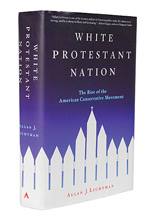
White Protestant Nation, The Rise of the American Conservative
Movement
Dangers of
'Christian Zionism' (March 2009)
are cited in new NCC brochure
New York, December 12, 2008 --
"Christian Zionism" is a dangerous movement that
distorts the teachings of the Church, fosters fear and
hatred of Muslims and non-Western Christians, and has
negative consequences for Middle East Peace. Click
here
Religious Right Watch Obama and Rick Warren click here
I believe that Obama et al are making a serious error in their
alliance with Rick Warren. The justifications given do not hold
water.... [F]or years [Obama has] been cultivating this powerful,
Austrian school-informed builder of an international religious
empire; who has big sway with governments in Africa and Asia. Some
of those same governements are into the brutal represssion and
perseuction of gay people. What kind of programs do you suppose
Rick Warren, who some people say is "great" on combatting
HIV/AIDS, can help develop when he is all about driving gay people
underground in Africa? Economics? Health care? Civil Rights?
When Christianity Is UnAmerican
By Terri Murray
There is a growing
chasm between the values of America's founders and the
values of the theocratic Christian right.
The Christian right claim
that their version of authoritarianism is a more authentic
interpretation of American values than the Enlightenment
values so cherished by our nation's forebears. But their
values are irreconcilable with those of America's past.
Here's how, in an incredibly lucid analysis.
Pope Benedict XVI has
called for the formation of a “true world political
authority.
In response to the world
financial crisis, Pope Benedict XVI has called for the formation
of a “true world political authority.” This new “authority” would
enforce global economic, environment and immigration policies to
help construct a social order that “conforms to the moral order.”
The call comes in the pope’s recently released encyclical,
entitled Caritas in Veritate, or Love in Truth.
Such language seems to reflect predictions that Seventh-day
Adventist have made for many years that at a time of international
crisis, religious leaders would call for international enforcement
of moral rules and standards. Is the Pope’s recent letter a
fulfillment of those predictions?
A full reading of the letter is needed to answer this question.
Much of the letter contains materials that Adventists along with
most Christians would agree with. It examines the current
global economic and political order, and criticizes it for
creating too great a divide between the rich and poor, between the
haves and have-nots.
Much of the Pope’s social justice concern reflects well the
message of the book of James, which rebukes the rich of the world
in the last days for oppressing and misusing the poor (James
5:1-6). The Pope’s critique of unrestrained, unregulated
capitalism, and his call for ecological and community stewardship
by businesses and corporations echoes the ethos of the prophets of
the Old and New Testaments. His call can be a reminder to
all Christians that our ethics and responsibility do not stop at
the church steps, or once we have paid tithes and offerings.
We need to take our ethics of stewardship, sharing, and caring
into our daily lives and businesses.
We can also appreciate his cautioning that rights cannot be
pursued and promoted in the absence of related duties. He
notes correctly that with freedom must come some measure of
responsibility, or the very conditions of freedom will
disappear. We also welcome his acknowledgement of the
importance of religious freedom and the threat to it by states and
regimes that promote secularism, and wish to marginalize religion
in society and the public square.
But we are concerned when the Pope, a religious, spiritual leader
seeks to advise the governments of the world on the creation of a
worldly, political entity that will implement global political,
economic and moral policy through force and coercion. The
Pope is clear on this latter point. He says that his
proposed “political body” should be “vested with the effective
power to ensure security for all, regard for justice, and respect
for rights. Obviously it would have to have the authority to
ensure compliance with its decisions from all parties.”
Jesus Christ, whom the Pope claims to represent here on earth,
very clearly said that “kingdom was not of this world: if my
kingdom were of this world, then would my servants fight . . . but
my kingdom is not from here” (John 18:36). A political
body “vested” with “power” to ensure “security” and “compliance,”
as the Pope recommends, will obviously have to use a police or
military force. What qualifies the Pope to make
recommendations or suggest policies for the creation of such an
entity?
A centralized, armed global authority would represent a
significant collection of power and authority. As we
know from history, and we are reminded by the Catholic historian
and thinker, Lord Acton, “power corrupts, and absolute power
corrupts absolutely.” It would seem unwise, based on human
experience and wisdom, to vest a central, global traffic cop with
sufficient power and oversight to police the world.
Some may argue that the Pope is not suggesting he or his church be
in charge of such an authority, but rather proposing that some
other body take these steps to stabilize our world economy.
And yet this cannot be the full argument. The letter makes
clear that the policies carried out by the entity would be to
construct a “social order” that “conforms to the moral
order.” The Pope’s choice of words is telling. He does
not say “some moral order,” or “a moral order,” but “the moral
order.” He clearly has a certain moral order in mind. Could
this be any other moral order than the one articulated and taught
by the Catholic Church?
The actual governing and wielding of the sword, or rifle, or
bayonet, of the global authority might be by non-religious, state
powers. But it would seem that the Pope must envision that
they would do so with some connection with Catholic Church
leadership, or teaching, or both. It cannot be that the Pope
is calling for the creation of an authority and the implementation
of a social and moral order, and then he plans to have no role, or
say, in how it is to be implemented. Evidence to support
this is virtually the entire history of the Middle Ages, where
classic Catholic teaching called for a distinction between church
and state, but with a full cooperation, where the state wielded
the sword on behalf of “the moral order” of the church.
Given this history, and the abuses that flowed from it--including
the Crusades, the Inquisition, and the war on heretical groups
such as the Waldenses--it seems unwise for the Pope to thrust
himself into the role of lead counselor on the enforcement of an
economic, social and moral order. But given prophetic
insights, it is not unexpected.
So does this letter fulfill Adventist predictions of an end-time
enforcement of international religious morality? No, not
yet. This letter is just talk and ideas. But talk and ideas
are meant to lead to action. And during times of calamity
and crisis, ideas that would usually be ignored often gain more
traction. The consequences and impact of this letter bear close
watching, as the cost of liberty is constant vigilance.
____________
Nicholas P. Miller is director of the International Religious
Liberty Institute at Andrews University in Berrien Springs,
Michigan.
WE NEED AUTHENTICALLY CHRISTIAN POLITICIANS
WE NEED AUTHENTICALLY CHRISTIAN POLITICIANS
VATICAN CITY, 21 MAY 2010 (VIS) - The Holy Father today
received participants in the twenty-fourth plenary assembly of
the Pontifical Council for the Laity who are currently meeting
to examine the theme: "Witnesses to Christ in the political
community".
The Pope told them that, although the "technical formation of
politicians" is not part of the Church's mission, she reserves
the right to "pass moral judgment in those matters which regard
public order when the fundamental rights of the person or the
salvation of souls require it".
"It is up to the lay faithful to show - in their personal and
family life, in social cultural and political life - that the
faith enables them to read reality in a new and profound way,
and to transform it", he said.
"It is also the duty of the laity to participate actively in
political life, in a manner coherent with the teaching of the
Church, bringing their well- founded reasoning and great ideals
into the democratic debate, and into the search for a broad
consensus among everyone who cares about the defence of life and
freedom, the protection of truth and the good of the family,
solidarity with the needy, and the vital search for the common
good".
The Holy Father went on: "There is a need for authentically
Christian politicians but, even more so, for lay faithful who
bear witness to Christ and the Gospel in the civil and political
community. This need must be reflected in the educational
prospectus of the ecclesial community and requires new forms of
presence and support from pastors. Christian membership of
associations, ecclesial movements and new communities can be a
good school for such disciples and witnesses, supported by the
charismatic, community, educational and missionary resources of
those groups".
The Pope explained how "the spread of a confused cultural relativism, and of a utilitarian and
hedonistic individualism weakens democracy and favours the
dominance of strong powers. We must recover and reinvigorate
authentic political wisdom; be demanding in what concerns our
own sphere of competency; make discriminating use of scientific
research; face reality in all its aspects, going beyond any kind
of ideological reductionism or utopian dream; show we are open
to true dialogue and collaboration, bearing in mind that
politics is also a complex art of equilibrium between ideals and
interests, but never forgetting that the contribution of
Christians can be decisive only if knowledge of faith becomes
knowledge of reality, the key to judgement and transformation.
What is needed is a true 'revolution of love'". AC/VIS 20100521 (430)